
25th Anniversary Celebrations of the Centre for Brazilian Studies of the University of Salamanca (CEBUSAL)
From 2nd-3rd of June 2026, researchers based in Europe and Brazil to celebrate the 25th anniversary of the Centre for Brazilian Studies of the University of Salamanca (CEBUSAL)- the only one of its kind in Spain. The event provided an opportunity for participants to share experiences of network-building, conducting research and maintaining institutions related to Brazilian studies. Dr Victoria Adams represented the University of Leeds and the European Network of Brazilianists Working in Cultural Analysis (REBRAC) at the event.
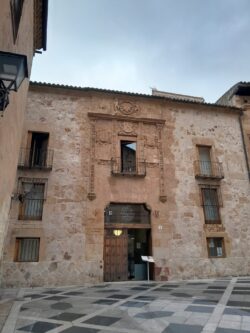
CEBUSAL's 25th anniversary celebrations were held in the historical Maldonado Palace
Over the course of two days, scholars enjoyed a range of presentations, exchanged ideas over cups of coffee, and explored some of the University of Salamanca’s most famous sites. The Brazilian Ambassador to Spain also accompanied the gathering’s proceedings. During a visit to the institution’s Historical Library participants were treated to a view of an early edition of Pêro Magalhães de Gândavo’s First History of Brazil. This early modern text detailed Brazil’s landscape and peoples to encourage settlers to move there. Its presence in the library and intended function invite reflection on the longstanding links between Brazil and the Iberian Peninsula.
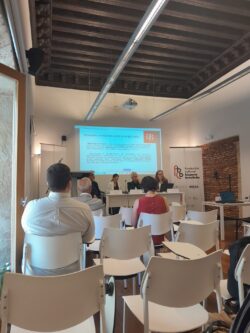
Participants present at CEBUSAL's 25th anniversary celebrations
Institutions and networks of various ages and scales presented at the event. Dr Eva Batlicková of Masaryk University shared plans to develop a Centre of Brazilian Studies in the Czech Republic, while Professor Monica Dantas, Director of the Institute of Brazilian Studies (IEB) at the University of São Paulo, gave a keynote speech that reflected on the past, present and future of the institute founded in 1962 by seminal historian Sérgio Buarque de Holanda. Her analysis underscored how the IEB’s innovative interdisciplinary approach has revolutionised the study of Brazilian history and culture since its foundation.
Discussions about the future of the Brazilian studies focused on:
- how to showcase the importance Brazilian studies and the country’s position at the forefront of global phenomena including climate change, platformisation and urbanisation
- balancing the need to bring Brazilian studies into dialogue with other disciplines without hiding or subsuming their specificities
- approaches to funding centres and networks for Brazilian studies, in particular via partnerships between governmental bodies and NGOs
- the challenges and opportunities of language teaching in an age of AI and of designing higher-education courses that equip students for an unpredictable future
- the importance of network building to support knowledge exchange between disciplines, to disseminate Brazilian thought, and to support young scholars
Recordings of presentations given at the gathering are available on CEBUSAL’s YouTube channel.
Andreia Mondoni of the Instituto Guimarães Rosa also shared a selection of resources to support the teaching of Brazilian Portuguese and culture.
To mark the occasion, scholars at the CEBUSAL had prepared an exhibition to recount its history. Hosted in the sixteenth-century Palacio de Maldonado, the panels of this exhibition examined how the centre emerged from a moment of increased exchange between Spain and Brazil at the turn of the millennium. It argued that this followed a long period of ‘distant friendship’ between Spain and Brazil resulting from their simultaneous cultural ties and linguistic differences. The exhibition then detailed the central role played by CEBUSAL in promoting relations between the two countries, as well as how it has served as key site for examining their responses to issues such as climate change and the Covid-19 pandemic through events and publications such as its Revista de Estudios Brasileños.

Posters advertising CEBUSAL's 25th anniversary celebrations and the accompanying exhibition hosted in the Maldonado Palace
Participants also visited an exhibition entitled ‘Tropicalisms: Psychedelia, the Avant-garde, and Cultural Cannibalism in Brazil (1967–1970)’ produced as part of the [CON]TEMPO Festival, which in 2026 is dedicated to Brazil.
The CEBUSAL’s distinguished history and the vibrancy of its recent anniversary celebrations suggest its future is bright and scholars can look forward to gathering there for many years to come.